Hello everyone,
I would like to introduce Zaneria Online, a server inspired by Tibia version 7.72 and other servers, built on the engine by fusion32 with adjustments. Our goal is to preserve the atmosphere, mechanics, and gameplay of that era as much as possible while creating an active and rewarding experience for players interested in PvP Enforced.
Season 1 addresses this in two ways. First, by increasing the gap at higher armor equipment so that end-game armor feels like a meaningful upgrade. Second, by adjusting mid armor items to remove cases where equipment had identical or strictly worse stats,
The values below are intentionally conservative. Season 1 is intended as a calibration phase, and it is easier to increase values later if needed than to reduce them afterward.
Each season helps us refine balance, stability, and content direction, ensuring that the foundation of the 1x world is as solid and well-designed as possible.
Planned development focus includes:
While the current seasonal world will be active, we continue to develop and prepare the future 1x experience in parallel, ensuring that changes are meaningful, tested, and aligned with the overall direction of Zaneria.
Feedback, suggestions, and constructive criticism are always welcome.
I would like to introduce Zaneria Online, a server inspired by Tibia version 7.72 and other servers, built on the engine by fusion32 with adjustments. Our goal is to preserve the atmosphere, mechanics, and gameplay of that era as much as possible while creating an active and rewarding experience for players interested in PvP Enforced.
Rates (Season 1) | Open to suggestions
- Stages
- Level 1 - 20 30x
- Level 21 - 40 10x
- Level 41 - 65 5x
- Level 66 - 85 3x
- Level 86 - 999 2x
- 5x Skill Rate
- 3x Magic Rate
- 1x Drop Rate
- 2x Spawn Rate
- Original Regeneration
- Spells have to be purchased? (I'd like to hear your opinions regarding this)
Seasons
Zaneria Online is inspired by previous servers such as Waropolis and operates in seasonal cycles. Between seasons, we continue working on improvements and future content, with updates shared through our website and Discord community.Season 1 Changes
The original 7.x armor formula uses a flat, linear reduction, where each point of armor reduces incoming damage by roughly the same amount, regardless of armor. This works well in early stages like Rookgaard, but it does not scale particularly well into higher levels.Season 1 addresses this in two ways. First, by increasing the gap at higher armor equipment so that end-game armor feels like a meaningful upgrade. Second, by adjusting mid armor items to remove cases where equipment had identical or strictly worse stats,
The values below are intentionally conservative. Season 1 is intended as a calibration phase, and it is easier to increase values later if needed than to reduce them afterward.
Why does armor need rebalancing?
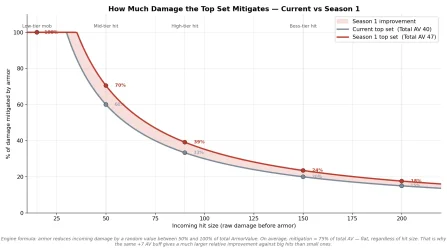
The engine applies armor as flat damage reduction, calculated at approximately 75 percent of the total Armor Value per hit, with some randomness. This means that the same +7 Armor Value that mitigates 75 percent of a 15 damage Rotworm hit only reduces about 5 percent of a 180 damage Demon hit. As a result, high-level equipment becomes less impactful at the stage where players expect it to matter the most.
The Season 1 adjustment, increasing the top equipment range from 43 to 50 Armor Value, raises the overall mitigation curve and ensures that high-level players gain a more meaningful reduction against the damage they commonly face.
Helmets
What is the impact?
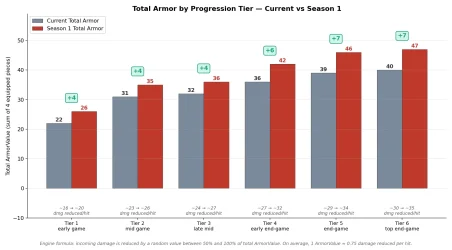
This comparison highlights how total Armor Value differs across four pieces of equipment before and after Season 1. The gap between early equipment and high-level equipment increases from 34 to 41 Armor Value points, providing a clearer and more rewarding progression for players who pursue later game upgrades.
The values above each category represent the average damage reduction per hit, calculated as approximately 75 percent of the total Armor Value. This offers a direct and practical view of how each equipment tier performs in combat.
The Result
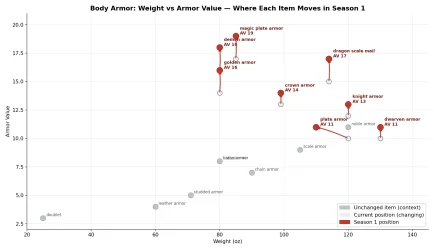
This scatter plot compares all body armors by weight on the x-axis and Armor Value on the y-axis. In the current state, certain inconsistencies appear where heavier equipment provides equal or even lower protection than lighter alternatives. For example, Dwarven Armor weighs more than Plate Armor while offering the same Armor Value, and Chain Armor is inferior to Brass Armor across all metrics.
In the Season 1 adjustments, this progression is made consistent. Heavier equipment now always provides higher Armor Value, creating a clear and logical relationship between weight and defensive strength.
The engine applies armor as flat damage reduction, calculated at approximately 75 percent of the total Armor Value per hit, with some randomness. This means that the same +7 Armor Value that mitigates 75 percent of a 15 damage Rotworm hit only reduces about 5 percent of a 180 damage Demon hit. As a result, high-level equipment becomes less impactful at the stage where players expect it to matter the most.
The Season 1 adjustment, increasing the top equipment range from 43 to 50 Armor Value, raises the overall mitigation curve and ensures that high-level players gain a more meaningful reduction against the damage they commonly face.
Helmets
- Leather helmet: 1 → 2
- Chain helmet: 2 → 3
- Devil helmet: 7 → 8
- Warrior helmet: 8 → 9
- Crusader helmet: 8 → 9
- Royal helmet: 9 → 10
- Demon helmet: 10 → 12
- Plate armor: 10 → 11, weight 120 oz → 110 oz
- Dwarven armor: 10 → 11
- Knight armor: 12 → 13
- Crown armor: 13 → 14
- Golden armor: 14 → 16
- Dragon scale mail: 15 → 17
- Demon armor: 16 → 18
- Magic plate armor: 17 → 19
- Knight legs: 8 → 9
- Crown legs: 8 → 9, weight 65 oz → 55 oz
- Golden legs: 9 → 11
- Demon legs: 9 → 11, weight 70 oz → 60 oz
- Steel boots: 3 → 4
- Golden boots: 4 → 5
What is the impact?
This comparison highlights how total Armor Value differs across four pieces of equipment before and after Season 1. The gap between early equipment and high-level equipment increases from 34 to 41 Armor Value points, providing a clearer and more rewarding progression for players who pursue later game upgrades.
The values above each category represent the average damage reduction per hit, calculated as approximately 75 percent of the total Armor Value. This offers a direct and practical view of how each equipment tier performs in combat.
The Result
This scatter plot compares all body armors by weight on the x-axis and Armor Value on the y-axis. In the current state, certain inconsistencies appear where heavier equipment provides equal or even lower protection than lighter alternatives. For example, Dwarven Armor weighs more than Plate Armor while offering the same Armor Value, and Chain Armor is inferior to Brass Armor across all metrics.
In the Season 1 adjustments, this progression is made consistent. Heavier equipment now always provides higher Armor Value, creating a clear and logical relationship between weight and defensive strength.
Future Plans
Zaneria Online is being developed with a long-term focus on a 1x rate world as the core experience. Our seasonal servers are an important step in that process, allowing us to test systems, gather feedback, introduce updates, and steadily improve the game before moving toward that final vision.Each season helps us refine balance, stability, and content direction, ensuring that the foundation of the 1x world is as solid and well-designed as possible.
Planned development focus includes:
- Ongoing improvements to core systems based on seasonal feedback
- Gradual introduction of new updates and content over time
- Continued refinement toward the long-term 1x experience
While the current seasonal world will be active, we continue to develop and prepare the future 1x experience in parallel, ensuring that changes are meaningful, tested, and aligned with the overall direction of Zaneria.
Feedback, suggestions, and constructive criticism are always welcome.
Last edited: