• There is NO official Otland's Discord server and NO official Otland's server list. The Otland's Staff does not manage any Discord server or server list. Moderators or administrator of any Discord server or server lists have NO connection to the Otland's Staff. Do not get scammed!
  • 2026 staff recruitment is open! Check it out and consider applying!

Question about OTCV8 Client (Modules removal)

archer32

Member
Joined
Feb 3, 2011
Messages
89
Solutions
1
Reaction score
9
Hi, just a quick question if somebody wouldn't mind answering

If I use OTCV8 and remove some modules like bot, actionbars, etc.. how can I make it so nobody can add those back into the game manually? It seems to be what can happen?

I want to just have like a clean older 8.6 style, not with all these extra bells and whistles.. but I like the function of like auto-updater and things like that... is there anything I am missing about this?

I like simple, slower paced RPG.. with the current OTCV8 to many buttons is just meh overwhelming to me... but I want everybody to be on the same page, and not being able to add extra things like actionbars or bot, battle window (if it was removed for example)

Thanks for input!
Have a blessed day
 
If I use OTCV8 and remove some modules like bot, actionbars, etc.. how can I make it so nobody can add those back into the game manually? It seems to be what can happen?
When you release your version of OTClient, there are multiple possibilities for players to add something:
  • just edit OTC files and add missing modules
  • connect using clean version of OTC - if you add some changes in your OTC, to block other clients (ex. edit RSA key), they can try to copy these changes into their client to make it able to login
  • write external bot and inject it into OTC

So you got to block these 2 scenarios. You cannot allow anyone to modify your files and you cannot allow anyone to use your files in his client - do not allow to mix clean OTC files with your files.

Obvious solution is to encrypt client ( Updated, encryption and compression (https://github.com/OTCv8/otclientv8/wiki/Updated,-encryption-and-compression) ), but there are 3 problems with basic OTCv8 encryption (all OTCv8 use same encryption password, which is defined inside OTCv8 .exe):
  • anyone can take file from your encrypted OTC and put it in his encrypted OTC - mix files to connect with his OTC
  • anyone can take file from his encrypted OTC and put it in your encrypted OTC - mix files to add module to your OTC
  • by default OTCv8 .exe - even one that you will compile on your own - contains --encrypt function, so if you change in C++ 'password' used to encrypt files (to make your files incompatible with official version of OTCv8), someone can still take clean OTCv8 files, run your .exe with --encrypt parameter and it will encrypt his files using your secret password, so he can mix his and your files, like in 2 examples above

To get basic protection, you got to do 3-4 things:
  • edit password used for encryption in OTCv8
  • prepare 2 .exe versions, one for you to encrypt client files you release (with --encrypt), one for players (without --encrypt)
  • modify RSA and some bytes in client-server communication protocol, to make it impossible to connect using clean OTC
  • [in case you want to remove bot module] you must edit C++ code that makes bot folder not encrypted

If someone can break it, he can also create simple OTC bot .exe to attack/use spells/heal etc., so no matter what else you do with your client, they will use modified client by injecting own bot C++/C# code into it.
 
When you release your version of OTClient, there are multiple possibilities for players to add something:
  • just edit OTC files and add missing modules
  • connect using clean version of OTC - if you add some changes in your OTC, to block other clients (ex. edit RSA key), they can try to copy these changes into their client to make it able to login
  • write external bot and inject it into OTC

So you got to block these 2 scenarios. You cannot allow anyone to modify your files and you cannot allow anyone to use your files in his client - do not allow to mix clean OTC files with your files.

Obvious solution is to encrypt client ( Updated, encryption and compression (https://github.com/OTCv8/otclientv8/wiki/Updated,-encryption-and-compression) ), but there are 3 problems with basic OTCv8 encryption (all OTCv8 use same encryption password, which is defined inside OTCv8 .exe):
  • anyone can take file from your encrypted OTC and put it in his encrypted OTC - mix files to connect with his OTC
  • anyone can take file from his encrypted OTC and put it in your encrypted OTC - mix files to add module to your OTC
  • by default OTCv8 .exe - even one that you will compile on your own - contains --encrypt function, so if you change in C++ 'password' used to encrypt files (to make your files incompatible with official version of OTCv8), someone can still take clean OTCv8 files, run your .exe with --encrypt parameter and it will encrypt his files using your secret password, so he can mix his and your files, like in 2 examples above

To get basic protection, you got to do 3-4 things:
  • edit password used for encryption in OTCv8
  • prepare 2 .exe versions, one for you to encrypt client files you release (with --encrypt), one for players (without --encrypt)
  • modify RSA and some bytes in client-server communication protocol, to make it impossible to connect using clean OTC
  • [in case you want to remove bot module] you must edit C++ code that makes bot folder not encrypted

If someone can break it, he can also create simple OTC bot .exe to attack/use spells/heal etc., so no matter what else you do with your client, they will use modified client by injecting own bot C++/C# code into it.

I think that's not exactly what he meant, he seems to want to make it impossible to just drag and drop bot module into his OTC directory, as it is possible even with encrypted client. So having encrypted client with not encrypted bot module is going to make the bot work. Basically even a kid can do this, so just removing bot folder and encrypting will not protect him from injecting bot into his OTC.
 
so just removing bot folder and encrypting will not protect him from injecting bot into his OTC.
Yes. That's why I posted that you have to modify OTCv8 C++ code to make it does not skip 'bot' folder while encrypting/decrypting.
I forgot to mention, that special version of .exe 'for players' should not allow any not encrypted .lua/.otmod/.otui files. By default OTCv8 reads encrypted and not encrypted files (you can mix them), by checking, if they start with ENC3 and if they do, it tries to decrypt them.

I also forgot that I released OTCv8 with bot removed and blocked a month ago :D
When you ( @Unknown Soldier ) posted your answer about blocking "bot" module, I though "I made it for someone and he allowed me to release code".
 
Last edited:
Yes. That's why I posted that you have to modify OTCv8 C++ code to make it does not skip 'bot' folder while encrypting/decrypting.
I forgot to mention, that special version of .exe 'for players' should not allow any not encrypted .lua/.otmod/.otui files. By default OTCv8 reads encrypted and not encrypted files (you can mix them), by checking, if they start with ENC3 and if they do, it tries to decrypt them.

I also forgot that I released OTCv8 with bot removed and blocked a month ago :D
great release
 
Yes. That's why I posted that you have to modify OTCv8 C++ code to make it does not skip 'bot' folder while encrypting/decrypting.
I forgot to mention, that special version of .exe 'for players' should not allow any not encrypted .lua/.otmod/.otui files. By default OTCv8 reads encrypted and not encrypted files (you can mix them), by checking, if they start with ENC3 and if they do, it tries to decrypt them.

I also forgot that I released OTCv8 with bot removed and blocked a month ago :D
When you ( @Unknown Soldier ) posted your answer about blocking "bot" module, I though "I made it for someone and he allowed me to release code".
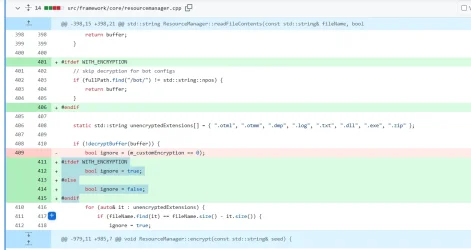
@Gesior.pl Hello sir, one little question, with your otclientv8 released version, this point: "I forgot to mention, that special version of .exe 'for players' should not allow any not encrypted .lua/.otmod/.otui files. By default OTCv8 reads encrypted and not encrypted files (you can mix them), by checking, if they start with ENC3 and if they do, it tries to decrypt them."

is fixed or not?
Because i can't understand this:
1761019755624.webp
You're ignoring the failed decrypted files if client is encrypted, shouldn't be the opposite? I'm a little bit confused sorry.

Thanks!
 
Last edited:
You're ignoring the failed decrypted files if client is encrypted, shouldn't be the opposite? I'm a little bit confused sorry.
C++ definition WITH_ENCRYPTION is reversed in OTCv8. It means that client has code to 'encrypt' (run with --encrypt param), not only 'decrypt'.
Client with flag WITH_ENCRYPTION is for admin of OTS, without is for players.

My version of client with WITH_ENCRYPTION works with encrypted and not encrypted files.
Without WITH_ENCRYPTION, it works only with encrypted files.

I did not add WITH_ENCRYPTION, it was in OTCv8 before. I just added it to few extra functions.
 
Thank you very much. Incredibly i followed all steps: changed the key, compilled the exes without the flags, and other changes. I even changed a bit the algorith method, and still, incredibly, some people in my server told me that they pay $25 to a brazilian guy, you pass him the encrypted client, and he returns the same client, encrypted but with the game_bot module integrated. They sent me the client and it's true

Idk if the reason is that i edited the code a bit, maybe they can easily see the key with an hex editor in the exe.
Thanks anyway! and sorry for the ignorance :P

C++:
// ===== Clave fija (NO usa k) =====
static constexpr uint32_t FIXED_KEY[4] = {
    0xfb0b8607, 0x112e75cb, 0x578217b0, 0xeb52b089
};


#ifdef WITH_ENCRYPTION
void Crypt::bencrypt(uint8_t* buffer, int len, uint64_t /*k*/) {
    // usa FIXED_KEY, no k
    const uint32_t* key = FIXED_KEY;

    uint32_t y, z, sum;
    uint32_t* v = (uint32_t*)buffer;
    unsigned rounds, e;
    int p, n = (len - (len % 4)) / 4;
    if (n < 2) return;

    rounds = 6 + 52 / n;
    sum = 0;
    z = v[n - 1];

    do {
        sum += DELTA;
        e = (sum >> 2) & 3;
        for (p = 0; p < n - 1; ++p) {
            y = v[p + 1];
            z = v[p] += MX;
        }
        y = v[0];
        z = v[n - 1] += MX;
    } while (--rounds);
}
#endif

void Crypt::bdecrypt(uint8_t* buffer, int len, uint64_t /*k*/) {
    // usa FIXED_KEY, no k
    const uint32_t* key = FIXED_KEY;

    uint32_t y, z, sum;
    uint32_t* v = (uint32_t*)buffer;
    unsigned p, rounds, e;
    int n = (len - (len % 4)) / 4;
    if (n < 2) return;

    rounds = 6 + 52 / n;
    sum = rounds * DELTA;
    y = v[0];

    do {
        e = (sum >> 2) & 3;
        for (p = n - 1; p > 0; --p) {
            z = v[p - 1];
            y = v[p] -= MX;
        }
        z = v[n - 1];
        y = v[0] -= MX;
        sum -= DELTA;
    } while (--rounds);
}
 
I
Thank you very much. Incredibly i followed all steps: changed the key, compilled the exes without the flags, and other changes. I even changed a bit the algorith method, and still, incredibly, some people in my server told me that they pay $25 to a brazilian guy, you pass him the encrypted client, and he returns the same client, encrypted but with the game_bot module integrated. They sent me the client and it's true

Idk if the reason is that i edited the code a bit, maybe they can easily see the key with an hex editor in the exe.
Thanks anyway! and sorry for the ignorance :P

C++:
// ===== Clave fija (NO usa k) =====
static constexpr uint32_t FIXED_KEY[4] = {
    0xfb0b8607, 0x112e75cb, 0x578217b0, 0xeb52b089
};


#ifdef WITH_ENCRYPTION
void Crypt::bencrypt(uint8_t* buffer, int len, uint64_t /*k*/) {
    // usa FIXED_KEY, no k
    const uint32_t* key = FIXED_KEY;

    uint32_t y, z, sum;
    uint32_t* v = (uint32_t*)buffer;
    unsigned rounds, e;
    int p, n = (len - (len % 4)) / 4;
    if (n < 2) return;

    rounds = 6 + 52 / n;
    sum = 0;
    z = v[n - 1];

    do {
        sum += DELTA;
        e = (sum >> 2) & 3;
        for (p = 0; p < n - 1; ++p) {
            y = v[p + 1];
            z = v[p] += MX;
        }
        y = v[0];
        z = v[n - 1] += MX;
    } while (--rounds);
}
#endif

void Crypt::bdecrypt(uint8_t* buffer, int len, uint64_t /*k*/) {
    // usa FIXED_KEY, no k
    const uint32_t* key = FIXED_KEY;

    uint32_t y, z, sum;
    uint32_t* v = (uint32_t*)buffer;
    unsigned p, rounds, e;
    int n = (len - (len % 4)) / 4;
    if (n < 2) return;

    rounds = 6 + 52 / n;
    sum = rounds * DELTA;
    y = v[0];

    do {
        e = (sum >> 2) & 3;
        for (p = n - 1; p > 0; --p) {
            z = v[p - 1];
            y = v[p] -= MX;
        }
        z = v[n - 1];
        y = v[0] -= MX;
        sum -= DELTA;
    } while (--rounds);
}

Just delete everyone that use bot. You'll see how fast people stop botting :D
 
Back
Top