

- Joined
- Nov 23, 2008
- Messages
- 2,058
- Reaction score
- 254
The Lazarus Project (TLP 7.4)
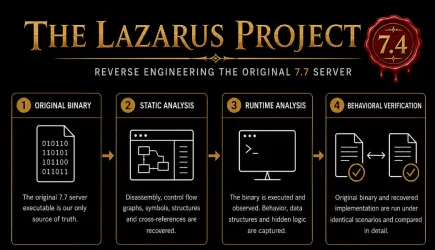
To do so this process has required several thousands of scripts triggering functions in runtime while comparing the behaviour for both the original binary and the recovered code.
The workflow wasn't designed to trust either the AI or the engineer. Every important recovery had to be supported by evidence before it became part of the project. That dramatically reduced interpretation and guesswork throughout the reconstruction.
Project Lazarus ultimately combines three independent sources of evidence into a single reconstruction.
- Static analysis established the structure.
- Runtime analysis established behavior that could not always be inferred statically.
- Behavioral comparison confirmed that the recovered implementation behaved like the original executable in practice.
-So what's the difference between a statically accurate project that is translated into readable compilable code that runs and Project lazarus where runtime and behaviour is also accurate?
Let's say there's a static reconstruction from the original binary dwarf information that been translated to readable code that compiles. That in itself, if done with AI puts you around 90% accuracy. Static analysis gives you things like
- combat formulas
- map loading architecture
- threading model
- serialization architecture
- networking architecture
- destructor ownership
- teardown order
- packet dispatch
- cleanup order
- lifecycle
- malformed packets and so on
Reconstructing the original game
The reconstructed engine was then systematically brought back to a true 7.4 state. This wasn't simply a matter of changing protocol versions or replacing the map. Months of historical research had already gone into understanding exactly what changed between the original 7.4 and later CipSoft versions before the reverse engineering process even began.
Restoring 7.4
A significant amount of work went into restoring gameplay mechanics, NPC behavior, movement rules, travel systems, protocol differences, progression, world interactions and many of the subtle details that changed after 7.4. Original mechanics such as overspawn, healing while standing on stacked creatures, removal of despawn range, walkable stack-height restrictions, fishing, regeneration, mana fluid formulas and magic level progression all had to be restored.Around 67 NPCs were individually reviewed and updated to match their original behavior. Monster loot was adjusted, soul points were removed, boats and carpets once again function without protection zone restrictions, moveuse actions were revalidated, map integrity was verified and numerous object definitions required correction due to the downgrade from 7.7 to 7.4
Those are only some of the larger changes. Countless of smaller adjustments were researched and restored throughout the project. Many are details most players will never consciously notice, but together they define how the original game actually feels to play. By the end of the project the challenge was no longer recovering major systems. It was making sure the thousands of small interactions matched the original experience as closely as possible.
Built for production
Project Lazarus was designed with production use as the end goal. The objective wasn't simply to recover source code. It was to reach a level of confidence where our reconstructed code could realistically replace the original binary and match it statically, at runtime and in behaviour.Why I'm not releasing it publicly
Project Lazarus is more than a recovered game server. It includes a production-ready ecosystem consisting of the game server, website, login manager, query manager, MySQL database schema and client. I previously released TVP 7.7 and TVP 7.4 hoping to bring the community together around a common 7.4 foundation that everyone could improve collectively.Unfortunately that wasn't the outcome. Much of the work was copied, repackaged and redistributed while relatively little found its way back into the original project. Because of that I've decided to take a different approach with Project Lazarus. Rather than making it publicly available, it will be shared with a limited number of people who genuinely intend to host an authentic 7.4 server and appreciate the amount of work that went into reconstructing it to the highest degree available. It's uncontested.
It's not intended for people who simply want to browse the source code or archive another repository. I'd rather see the project used to build long-term servers than become another endlessly copied repository.
So how do I obtain a copy?
My goal is simple. I know there's alot of people passionate about hosting 7.4 servers and if I get in touch with someone I feel is truly serious about it. He may have my blessing. It would require more than a hello however. I'd like to discuss your plans, your long-term intentions and how you expect to grow the server. This is not a collectible.
Last edited:


